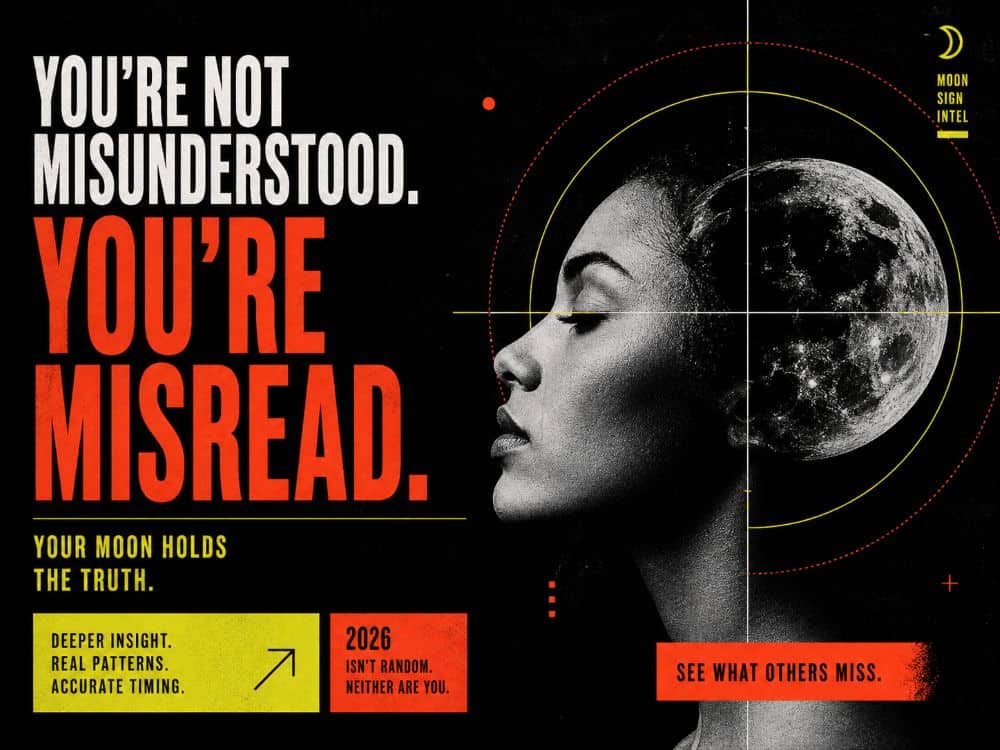
You’ve probably noticed this. You read your horoscope. It lands—partially. It describes a version of you, not the one you actually move through the world as.
Close enough to keep you reading. Not precise enough to change anything.
That gap matters more in 2026 than it ever has, because this isn’t a year that tolerates approximation.
The Pattern You Keep Running Into
People are reporting the same thing, across signs, across systems.
Relationships that look right on paper—don’t hold.
Timing that should work—doesn’t.
Identity that once felt stable—starts slipping.
This shows up as:
- Attraction without alignment
- Emotional reactions that don’t match your “sign”
- Decisions that feel right in the moment, wrong in hindsight
And the default explanation? “Transits are intense right now.”
That’s not wrong. But it’s incomplete.
What 2026 Is Actually Doing
This is a structural year. Not dramatic on the surface—but precise underneath.
Major planetary shifts aren’t just “influencing” you. They’re exposing where your internal timing is out of sync with external reality. That’s the real tension. Not chaos, but misalignment.
You’re operating on one layer of your chart. Your life is responding to another.
Where Most Astrology Stops Working
Most people are still interpreting themselves through simplified frameworks:
- Sun sign identity
- Basic compatibility charts
- Generic “2026 astrology predictions”
It creates a narrative instead of a system. When pressure increases—as it has now—that narrative starts breaking. You feel it as: “I should understand myself better than this.” You should. But only if you’re looking in the right place.

The Blind Spot: Emotional Architecture
Here’s the part most people miss: Your decisions don’t come from your Sun sign.
Your reactions don’t either. Your emotional timing—how you attach, withdraw, trust, doubt—comes from something deeper. Something quieterand far less discussed: Your Moon.
Why This Matters Now
In previous years, you could get by without precision. 2026 removes that buffer.
Relationship astrology compatibility is no longer about surface traits. It’s about emotional rhythm. Most people are out of sync without realizing it.
You’ve probably experienced this:
- You meet someone who “should” match you
- Conversations flow
- Values align
But something feels off. You can’t place it, so you override it. Later, it becomes obvious. That’s not intuition failing – you’re working with missing data.
The Accuracy Problem
There’s another layer to this. Birth chart accuracy is being questioned more than ever—quietly, but consistently. Especially as more people start exploring true sidereal astrology.
They’re noticing discrepancies:
- Planetary positions that don’t match lived experience
- Traits that feel assigned, not observed
- Timing predictions that miss
It creates doubt. Not in astrology itself—but in how it’s being applied.
And that doubt is valid, because most systems are built for accessibility, not precision.
What Precision Actually Looks Like
Precision doesn’t feel broad. It feels specific enough to be uncomfortable. It reveals patterns you didn’t consciously track—but immediately recognize. Not as inspiration, but rather confirmation.
That’s the difference.
The Missing Layer You Haven’t Fully Explored
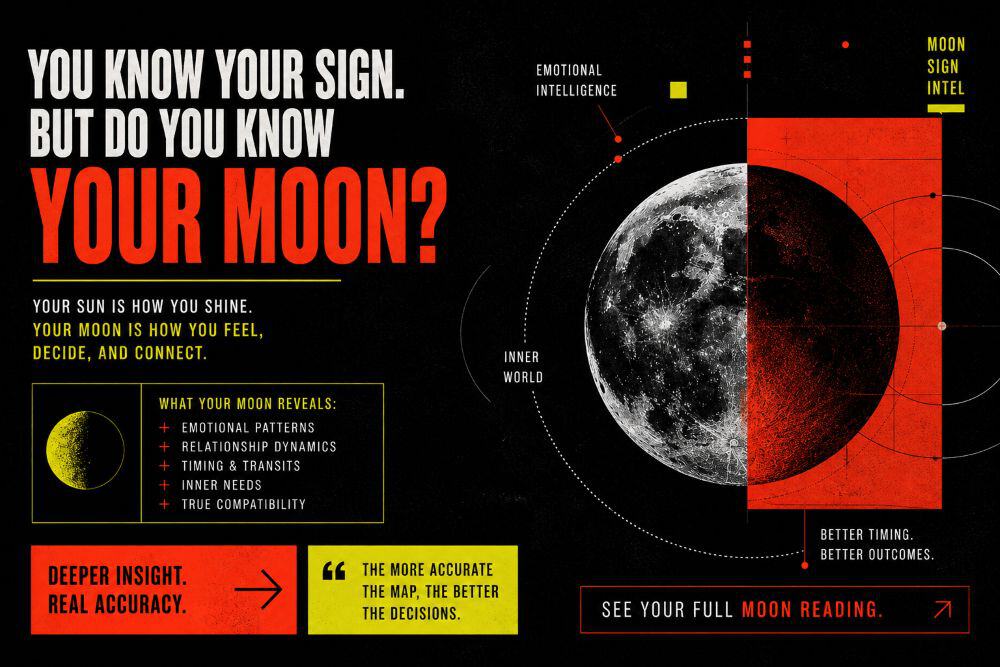
Most people know their Sun sign. Some know their rising. Very few have a detailed, structured understanding of their Moon.
Not just “your Moon is in X.”
But:
- How it processes emotional data
- How it affects your decision-making speed
- How it alters your perception of compatibility
- How it shifts your timing in relationships
This is where the gap closes.
A System That Actually Maps It
More people are starting to move toward deeper Moon-based analysis because it resolves inconsistencies.
The framework used here is different in one key way: It doesn’t generalize your emotional nature.
It maps it.
According to the system outlined in MoonReading’s approach to Moon signs, your Moon isn’t treated as a supporting detail. It’s central, structured and layered. Interpreted in relation to how you actually experience life—not how you’re supposed to. That distinction matters.

What Changes When You See It Clearly
Once you understand your Moon properly, patterns stop feeling random.
You start noticing:
Why you’re drawn to certain people—despite logic
Why you pull away at specific moments
Why some connections feel stable, and others feel urgent
It reframes relationship astrology compatibility entirely.
Not as: “Are we a good match?” But: “Do our emotional systems operate on compatible timing?”
That’s a different question. And it produces different answers.
Timing Stops Feeling Arbitrary
Astrology timing and transits become more precise when filtered through your Moon. Transits don’t affect everyone equally. They activate different emotional triggers based on your internal structure. Without that context, timing feels vague. With it, timing becomes predictable in a pattern-based way.
Identity Becomes Less Fragile
Another shift: You stop trying to reconcile conflicting versions of yourself, because they’re not conflicting – they’re layered.
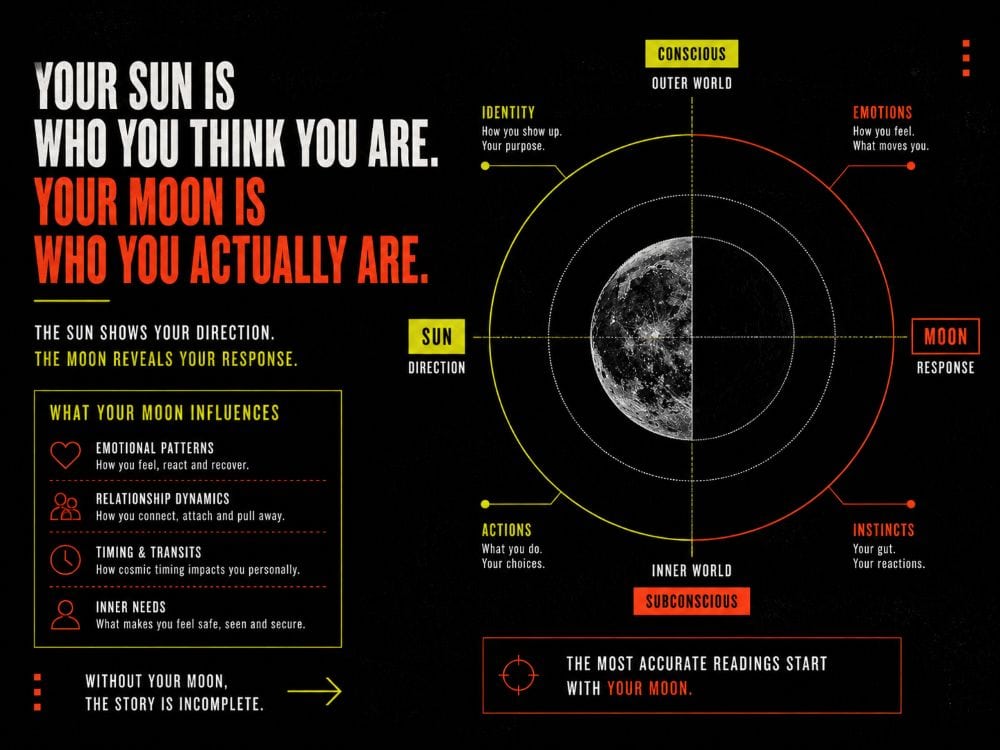
Your Sun describes direction. Your Moon describes response. Most people try to live through one. 2026 is forcing both into view. That’s why identity feels unstable for so many. It’s not breaking – it’s being recalibrated.
The Point Where Curiosity Becomes Necessary
At a certain point, surface-level understanding stops being satisfying. You don’t want more content. You want clarity – not broader interpretations but more accurate ones. That’s where this becomes practical.
What Comes Next (If You Actually Want Precision)
If you’ve recognized even part of this pattern, then you already know:
Something structured enough to:
- Map your emotional responses
- Explain your relationship patterns
- Clarify your timing
That’s exactly what this Moon-based system is built to do.
Are you ready to go deeper?
If you want to see how your own emotional architecture is configured and where your current patterns are coming from this is the next step.
Final Thought
Most people don’t lack self-awareness. They lack accurate frameworks. 2026 is making that distinction impossible to ignore.
FAQ
What makes MoonReading different from traditional astrology?
MoonReading focuses specifically on the Moon as the core of emotional processing, rather than treating it as a secondary factor. It uses a structured system to interpret how your Moon influences behaviour, timing, and relationships—making it more precise than generalized Sun-based readings.
Is MoonReading more accurate than tropical astrology?
It’s not about replacing tropical astrology—it’s about depth. MoonReading adds a layer of precision by analysing emotional patterns that standard tropical interpretations often simplify or overlook.
How does this relate to true sidereal astrology?
True sidereal astrology questions planetary positioning accuracy. MoonReading complements this by focusing less on surface positioning debates and more on how your Moon actually manifests in real-world behaviour.
Why do my birth chart readings feel inconsistent?
Most readings prioritize broad identity markers like Sun signs. Without a detailed understanding of your Moon, interpretations can feel partially accurate but ultimately incomplete.
Can MoonReading improve relationship compatibility insights?
Yes. It shifts compatibility analysis from surface traits to emotional timing and response patterns—often revealing why certain relationships feel “off” despite apparent alignment.
Do I need my exact birth time?
The more accurate your birth data, the more precise the reading. Moon-based systems rely on timing, so exact details improve clarity.
How does MoonReading help with astrology timing and transits?
It shows how transits interact with your emotional structure, making timing feel less random and more pattern-based.