
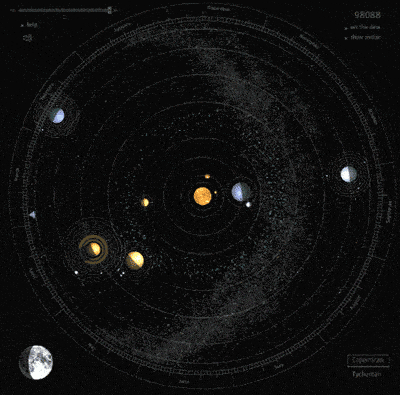
Astrology is often described as the language of the cosmos—but the real sentences of that language aren’t the signs alone. They’re the aspects: the angles the planets make to one another in your birth chart and in the sky right now. These angles are like ongoing conversations between different parts of your psyche, shaping how you love, how you work, when you feel blocked, and when life suddenly opens up.
In this guide, we’ll explore aspects as living “cosmic conversations” and show how understanding them can bring real clarity to your relationships, your timing, and your sense of purpose. We’ll move from intuitive, easy-to-grasp explanations into more nuanced insight, so whether you’re new to astrology or have been reading charts for years, you’ll find something you can immediately apply to your life.

1. What Are Aspects, Really? The Sky as a Conversation
When astrologers talk about “aspects,” we’re referring to the angles that planets form with each other when viewed from Earth. An aspect is created when two planets are a certain number of degrees apart—for example, 0°, 60°, 90°, 120°, or 180°.
Think of it like this:
- Each planet represents a psychological function or drive (for example, Venus for relating and pleasure, Mars for drive and assertiveness, Saturn for structure and responsibility).
- The aspect shows how those functions interact—whether they feel cooperative, tense, challenging, or heightened.
So if you’ve ever wondered, “Why do I keep repeating this pattern in relationships?” or “Why do I feel like I’m working against myself when it comes to money, career, or timing?”, you’re asking aspect questions.
This is why people searching for “how to understand natal chart aspects” or “how to interpret difficult aspects in astrology” are usually at a turning point: they’re ready to move beyond sun-sign horoscopes into the deeper geometry of their lives. Aspects are where astrology stops being generic and starts being personal.
2. The Major Aspects: The Core Cosmic Dialogues
There are many aspects, but the main ones that shape your inner narrative and life experiences are:
- Conjunction (0°): Planets sitting together, blending.
- Sextile (60°): Harmonious opportunity, things that flow if you engage them.
- Square (90°): Tension, friction, and growth through challenge.
- Trine (120°): Natural talent, ease, and supportive flow.
- Opposition (180°): Polarity, mirroring, and integration through “the other.”
Let’s break these down in more human terms, especially as they show up in love, timing, and purpose.
Conjunctions: Two Voices as One
A conjunction is like two characters speaking in unison.
- If you have Sun–Mercury conjunct, your identity and your mind are fused; you can’t help but think about yourself and speak your truth.
- If you have Venus–Mars conjunct, desire and attraction blend—relationships may feel intense, physical, and alive.
Conjunctions in transit (what’s happening in the sky right now) can mark times when a theme in your life becomes loud and undeniable, like a chapter heading: “This is the beginning of a new story.”
Sextiles: Invitations You Can Say Yes To
Sextiles are like friendly text messages from the universe: “This opportunity is here if you’re willing to act.”
- In the natal chart, a Moon–Venus sextile might show emotional intelligence in relationships; you’re not forced to use it, but when you do, things go more smoothly.
- In transits, sextiles often coincide with chances to expand your network, start creative collaborations, or make practical progress with less effort than usual—if you choose to engage.
Squares: The Productive Frictions
Squares are the aspects most people fear—and yet they’re often the ones that drive the deepest growth.
A square is like two inner voices pulling you in different directions:
- Mars–Saturn square can feel like wanting to charge ahead while hitting invisible brakes.
- Venus–Pluto square can show intensity in relationships, deep attachment, power struggles, and ultimately, profound transformation in how you love.
For people searching “what does a square mean in my birth chart?” or “how to work with challenging aspects,” what they’re really asking is, “How do I stop fighting myself?” Squares can feel frustrating, but they’re one of the strongest drivers of mastery, resilience, and self-awareness.
Trines: Your Natural Superpowers
Trines are the smooth-flowing aspects. They’re the parts of life that seem to “just work” when you give them any attention at all.
- Sun–Jupiter trine can bring optimism, generosity, and a sense of meaning that others feel drawn to.
- Mercury–Uranus trine might show quick insights, innovative thinking, and an ability to connect dots others miss.
Trines are also where you may unconsciously underestimate yourself because something feels too easy to be valuable. Understanding these aspects can help you recognize your natural gifts and build them into your purpose and career.
Oppositions: Mirrors in the Sky
Oppositions are the aspect of projection: the “you versus me” dynamic that shows up repeatedly in partnerships, colleagues, and family.
- Sun–Moon opposition can show a lifelong journey of balancing your outer life with your inner needs.
- Venus–Saturn opposition might manifest as fearing rejection or attracting partners who test your sense of worth and commitment.
Oppositions are a call to integration. They show you where you’re learning to hold both ends of a polarity rather than flipping between extremes.

3. Aspects and Relationships: The Scripts You Keep Repeating
When people look up things like “relationship astrology aspects,” “synastry aspects for compatibility,” or “why do I keep attracting the same type of partner?”, they’re searching for the invisible patterns shaping their love lives.
Natal Aspects: Your Relationship Template
Your birth chart aspects describe your default way of relating to others. For example:
- Moon square Venus: You might crave affection but feel unsure how to ask for it directly. You may swing between pleasing others and sudden emotional reactions.
- Venus trine Jupiter: You may naturally trust people, give generously, and attract supportive, expansive connections.
- Mars opposite Saturn: You might experience partners as either too controlling or too passive—until you learn to balance initiative and boundaries within yourself.
These patterns are not punishments. They are the “scripts” you carry into every connection. The power comes when you see the script clearly enough to rewrite it.

Are you interested in learning more?
If you’re looking to deepen this understanding, Astrology SA offers a range of insights and resources to help you keep unpacking these patterns over time in a grounded, non-sensational way.
Synastry and Composite Charts: Relationship as a Third Entity
Advanced astrology fans often work with synastry (comparing two charts) and composite charts (a chart for the relationship itself). Certain aspects between charts can show themes like:
- Venus conjunct another person’s Moon: strong emotional and romantic affinity.
- Saturn square the other’s Sun: commitment and growth but sometimes a sense of heaviness or obligation.
- Pluto aspects to personal planets: intense attraction, transformation, and sometimes power dynamics that need conscious handling.
Understanding these aspects doesn’t mean you should label relationships “good” or “bad.” Instead, it gives you language for what you’re feeling, so you can respond intentionally instead of reacting on autopilot.
If you want to deepen your understanding of how aspects shape your love life and attract more conscious connections, ongoing education and reflection are key.
That’s where a steady stream of high-quality astrology guidance becomes valuable—for example, curated content and insights from a specialized astrology community you resonate with.

4. Aspects and Timing: Why Some Moments Feel Fated
Timing is one of the reasons people turn to astrology when they feel stuck or on the brink of change. Searches like “best time to start a business astrology,” “Saturn transit meaning,” or “how to read transits and aspects” are really expressions of a deeper question: “How do I work with time instead of constantly pushing against it?”
This is where transiting aspects come in. These are the angles current planets form to your natal planets.
Personal Transits: The Seasons of Your Life
Some examples:
- A transiting Jupiter trine your natal Sun often corresponds with a season of growth, opportunity, and greater confidence. Things come together more easily, and you’re more likely to meet people or ideas that expand your world.
- A transiting Saturn square your Moon may bring emotional pressure or responsibility around family, home, or your inner life. It can feel heavy—but it’s also a period where emotional maturity and resilience can deepen.
- A transiting Uranus opposition to your natal Venus might coincide with a relationship “plot twist,” sudden attraction, or a redefinition of what freedom and commitment mean to you.
Seeing these transits as conversations rather than verdicts changes everything. Instead of “Saturn is punishing me,” you can ask, “What is Saturn trying to teach me about boundaries, patience, self-respect, and long-term commitment?”
Electional Mindset: Working With the Flow
Professional astrologers sometimes use electional astrology—choosing dates for important actions—but even if you never cast a full electional chart, you can cultivate an electional mindset:
- Notice when supportive aspects (like trines and sextiles) align with your personal planets. Those periods can be ideal for outreach, launches, important conversations, or making bold moves.
- Acknowledge when heavier aspects (like Saturn or Pluto squares) are active. Those might be times to focus on restructuring, clearing out what no longer works, or doing the deep work that isn’t Instagram-pretty but is life-changing.
This kind of “astrology for life planning” is not about controlling everything; it’s about understanding the terrain so your choices are better informed. If you’re building a career, changing direction, or trying to balance work, relationships, and personal growth, tracking aspects to your chart is one of the most practical tools you can use.

5. Aspects and Life Purpose: Aligning Inner Voices
Many people search for phrases like “astrology for life purpose,” “north node and career,” or “using astrology for personal growth.” Aspects are central to all of those questions because they show how your inner drives support or challenge each other as you move toward fulfilling work and meaningful contribution.
Purpose Isn’t One Planet—it’s a Pattern
Your life purpose is rarely encoded in a single placement. Instead, it’s the synergy of:
- The Sun (core vitality and expression).
- The Midheaven or 10th house (public role, reputation, career direction).
- The Nodes of the Moon (karmic trajectory).
- The aspects connecting these points to the rest of your chart.
For example:
- Sun trine Saturn connecting to your Midheaven might describe a calling to build something lasting—leadership, governance, mentorship, or craft mastery that develops over time.
- A tense square between Mars and Neptune may show the need to refine discernment: moving from scattered effort or confusion into purposeful, aligned action, often in creative or healing fields.
- Jupiter aspects to the Nodes can point to growth through teaching, traveling, or spreading ideas that uplift others.
Working With Your Chart Rather Than Against It
The goal is not to chase a “perfect destiny” but to work with your wiring:
- If you have a lot of squares, your path may involve trial-and-error and developing resilience; you grow by meeting challenges.
- If you have many trines, you might need to consciously claim your gifts instead of assuming they’re nothing special.
- If oppositions dominate, your purpose may involve bridging worlds—helping others see both sides of an issue, working across cultures or disciplines, or holding space for differences.
A steady practice of reflecting on your aspects—through journaling, transit tracking, or ongoing education—can turn your chart into a living guide rather than a static diagram. That’s where regular, thoughtful astrology content becomes invaluable.
Are you interested in learning more?
If you’d like structured guidance in deepening this relationship with your chart, you can explore the learning resources and newsletters offered here. It’s a simple way to stay in dialogue with your chart instead of only checking in during crises.
6. Making It Practical: How to Start Listening to Your Own Cosmic Conversations
You don’t need to become a professional astrologer to work with aspects meaningfully. You just need a few core practices and a willingness to observe your life with curiosity instead of judgment.
Here are some practical steps:
- Get a birth chart with aspects visible
- Use any reliable chart calculator (many online tools are free) and choose a setting that shows aspect lines.
- Note which planets are joined by aspects, and which aspect types show up the most (conjunction, square, trine, etc.).
- Identify your “loudest” aspects
- Look for aspects involving your Sun, Moon, Ascendant ruler, or chart angles (Ascendant, Descendant, Midheaven, IC).
- Also pay attention to aspects involving Saturn, Uranus, Neptune, and Pluto—these often describe deeper themes of transformation and maturation.
- Translate aspects into real-life questions
- Sun square Saturn: Where do I feel like I must work twice as hard for recognition, and how can I build self-respect from within instead of chasing external approval?
- Venus trine Neptune: How can I express compassion and creativity in my relationships without losing my boundaries?
- Mars opposite Jupiter: Where am I oscillating between playing small and overextending, and what does balanced confidence look like for me?
- Track transits in a simple way
- You don’t need to monitor every aspect. Start with the slower planets (Jupiter, Saturn, Uranus, Neptune, Pluto) making aspects to your Sun, Moon, or Ascendant.
- Note the dates and keep a short journal: How do you feel? What events or themes show up? Over time, you’ll recognize your own patterns of “cosmic weather.”
- Revisit your chart regularly
- Rather than trying to decode everything at once, pick one aspect and live with it for a few weeks. Notice how it operates in your relationships, your work, your inner landscape.
- Astrology is less about having all the answers and more about asking better questions. The aspects give you those questions.
This kind of steady, reflective approach is where astrology becomes a long-term ally for personal development, not just a one-time curiosity.

7. The Heart of It: Aspects as an Ongoing Inner Dialogue
If you take only one idea from this post, let it be this: aspects are conversations, not verdicts.
- A difficult aspect is not a life sentence; it’s an ongoing dialogue where two parts of you are learning to coexist.
- A harmonious aspect is not a guaranteed success; it’s a supportive inner voice that you can choose to amplify.
- A transit is not “fate” descending; it’s a season of your life inviting specific kinds of growth, release, or action.
When you start to hear your chart this way, you stop asking, “Is this good or bad?” and start asking, “What is this part of me trying to say?” That shift alone can soften self-judgment, deepen self-awareness, and improve your choices in relationships, work, and daily life.
Astrology, at its best, isn’t about predicting every twist and turn; it’s about making you more conscious of the patterns you’re already living. The more fluent you become in your own cosmic conversations, the more you can move through life with grounded confidence, compassion for yourself and others, and a clearer sense of direction.
FAQ: Aspects, Relationships, Timing, and Purpose
1. What are aspects in astrology, and why do they matter so much?
Aspects are the angles planets form with each other in your birth chart and in the current sky. They matter because they show how different parts of your personality interact—where you experience flow, tension, opportunity, and growth. Understanding aspects helps you interpret your natal chart and transits more accurately, moving beyond one-size-fits-all horoscopes.
2. How do I read aspects in my birth chart as a beginner?
Start by identifying the main aspects (conjunctions, sextiles, squares, trines, oppositions) between your Sun, Moon, Ascendant ruler, and personal planets (Mercury, Venus, Mars). Look up each aspect individually, then reflect on how those meanings show up in your relationships, work, and emotional life. A step-by-step approach makes learning how to read aspects in your natal chart far less overwhelming.
3. Which aspects in synastry are important for long-term relationships?
In relationship astrology, aspects between the Moon, Venus, Mars, and Saturn are especially important. Harmonious aspects (like trines and sextiles) can indicate ease and mutual support, while challenging aspects (like squares and oppositions) can signal areas of growth and potential friction. The key is not to chase “perfect” synastry but to understand how your combined aspects describe the relationship’s strengths and lessons.
4. How do aspects affect life timing and major decisions?
When current planets form aspects to your natal planets—called transits—they describe themes and moods that influence your timing. Supportive transits can coincide with periods when it’s easier to take risks, start new projects, or expand. More challenging transits may bring lessons around boundaries, letting go, or restructuring. Learning how to interpret transiting aspects can help you plan important decisions with greater awareness.
5. Can astrology really help with finding my life purpose?
Astrology doesn’t hand you a single job title as your life purpose, but it does reveal the energies and themes that are most meaningful for you. Aspects to your Sun, Midheaven, and Nodes of the Moon are especially important. By studying these patterns, you can better understand what kinds of work, roles, and contributions feel deeply aligned, and which directions drain you or keep you stuck.
6. How often should I check my transits and aspects?
You don’t need to check your transits every day. Many people find a weekly or monthly review more grounding, especially when focusing on slower-moving planets. The goal isn’t to obsess over every aspect but to develop a steady, supportive relationship with your chart. Regular, thoughtfully curated astrology content—like newsletters or in-depth articles—can make it easier to stay engaged without getting overwhelmed.